Aligning Sales and Marketing around a predictive scoring model is the difference between a high-octane revenue engine and a “black box” that everyone ignores. In 2026, predictive scores must be transparent, actionable, and tied to a strict Service Level Agreement (SLA).
To ensure your model doesn’t produce “numbers in a vacuum,” use this checklist to sync your teams on what those scores actually mean for their daily workflows.
2026 Sales-Marketing Alignment Checklist
Phase 1: Pre-Rollout Definition & Strategy
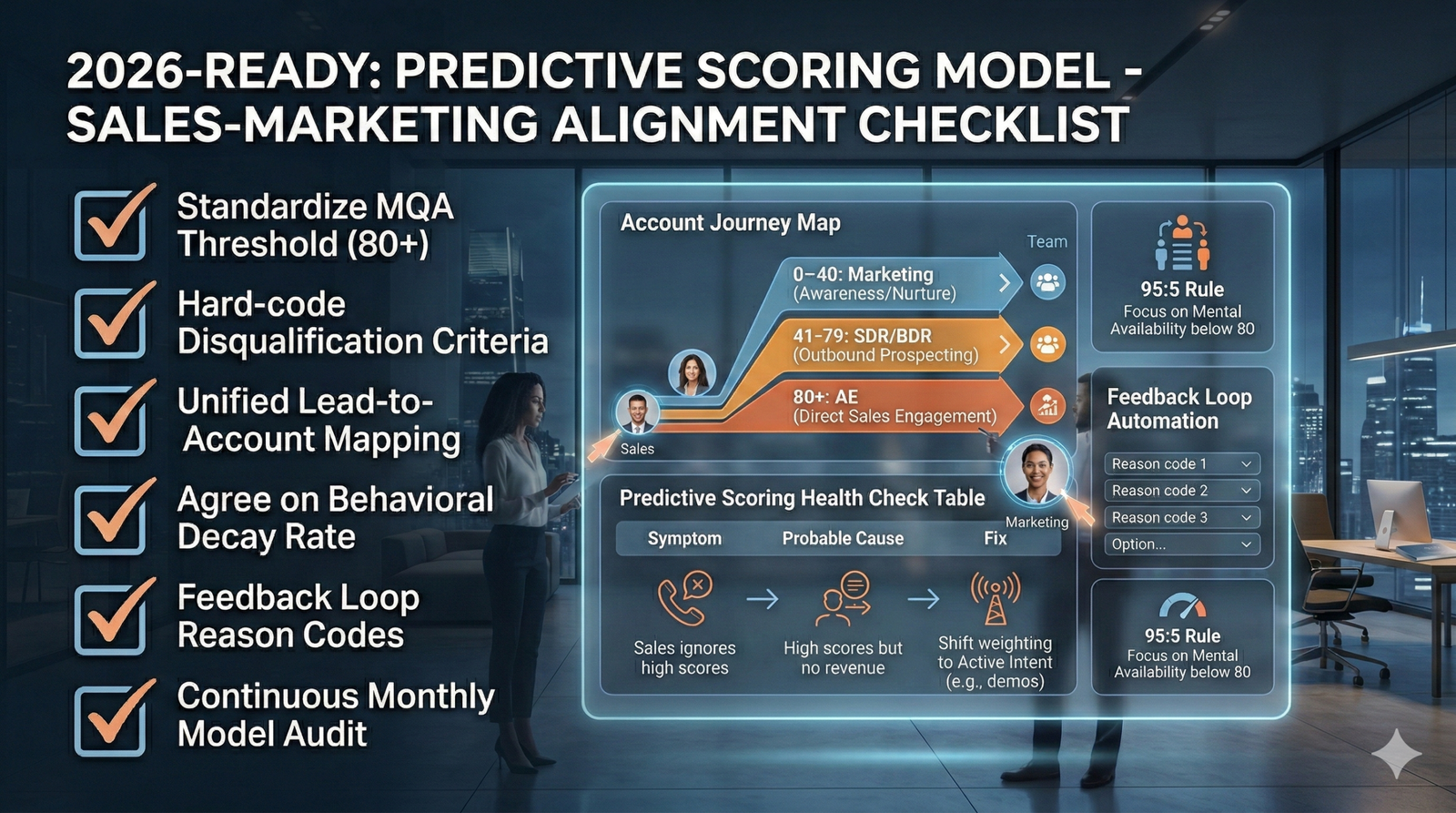
- [ ] Standardize the “Threshold”: Agree on the exact score that triggers a “Hand-off” (e.g., An account score of 80+ is an MQA—Marketing Qualified Account).
- [ ] Define “Disqualification” Criteria: List firmographic deal-breakers (e.g., restricted regions or industries) to “hard-code” into the model’s negative weighting.
- [ ] Map the “Account Journey”: Determine ownership based on score tiers:
- Score 0–40: Marketing (Awareness/Nurture)
- Score 41–79: SDR/BDR (Outbound Prospecting)
- Score 80+: AE (Direct Sales Engagement)
Phase 2: Technical Setup & Data Integrity
- [ ] Unified Lead-to-Account Mapping: Ensure your CRM automatically links leads to parent accounts. Fragmented activity on orphaned records kills scoring accuracy.
- [ ] Behavioral Decay Agreement: Agree on how fast scores should drop (e.g., a website visit’s value drops by 50% after 14 days of inactivity).
- [ ] Feedback Loop Automation: Create a “Reason Code” field in the CRM. If Sales rejects a high-scoring account, they must select why (e.g., “Wrong Persona,” “Existing Customer”).
Phase 3: Operational Rules of Engagement
- [ ] SLA Timing: Define follow-up speed for “High Priority” scores. In 2026, the standard for a high-intent signal is under 15 minutes.
- [ ] Content Personalisation Sync: Marketing must provide the “Why.” If a score spiked due to a “Security Whitepaper,” Sales outreach should lead with security, not features.
- [ ] Dashboard Transparency: Build a shared “Command Center” visible to both teams to track conversion rates per score tier and “False Positives.”
Predictive Scoring “Health Check”
Use this table during your monthly sync to identify and repair alignment friction:
| Symptom | Probable Cause | Fix |
| Sales ignores high scores | Lack of trust in the “Why” | Expose the “Signal” (e.g., “Visited pricing 3x”). |
| High scores / No revenue | Model is weighted on “Noise” | Increase points for Intent (Demos); reduce for Passive (Blogs). |
| Too many MQAs to handle | Threshold is too low | Raise the score required for an “MQA” alert. |
Post-Rollout: Continuous Optimisation
- Monthly “Model Audit”: Review the top 10 “Lost” deals. Did the model see them coming? If not, identify the missing signal.
- Incentive Alignment: Ensure Marketing is measured on Pipeline Value (driven by high scores), not just lead volume.
The 95:5 Reality Check: Remember that accounts in the 41-79 range are often your “95%” (Out-of-market). The goal here isn’t to force a sale, but to build Mental Availability so they hit the 80+ threshold sooner.
Summary
Predictive scoring is only as powerful as the trust behind it. By defining clear “Rules of Engagement” and maintaining a feedback loop, you move away from “guessing” and toward a data-driven Account-Based Experience.