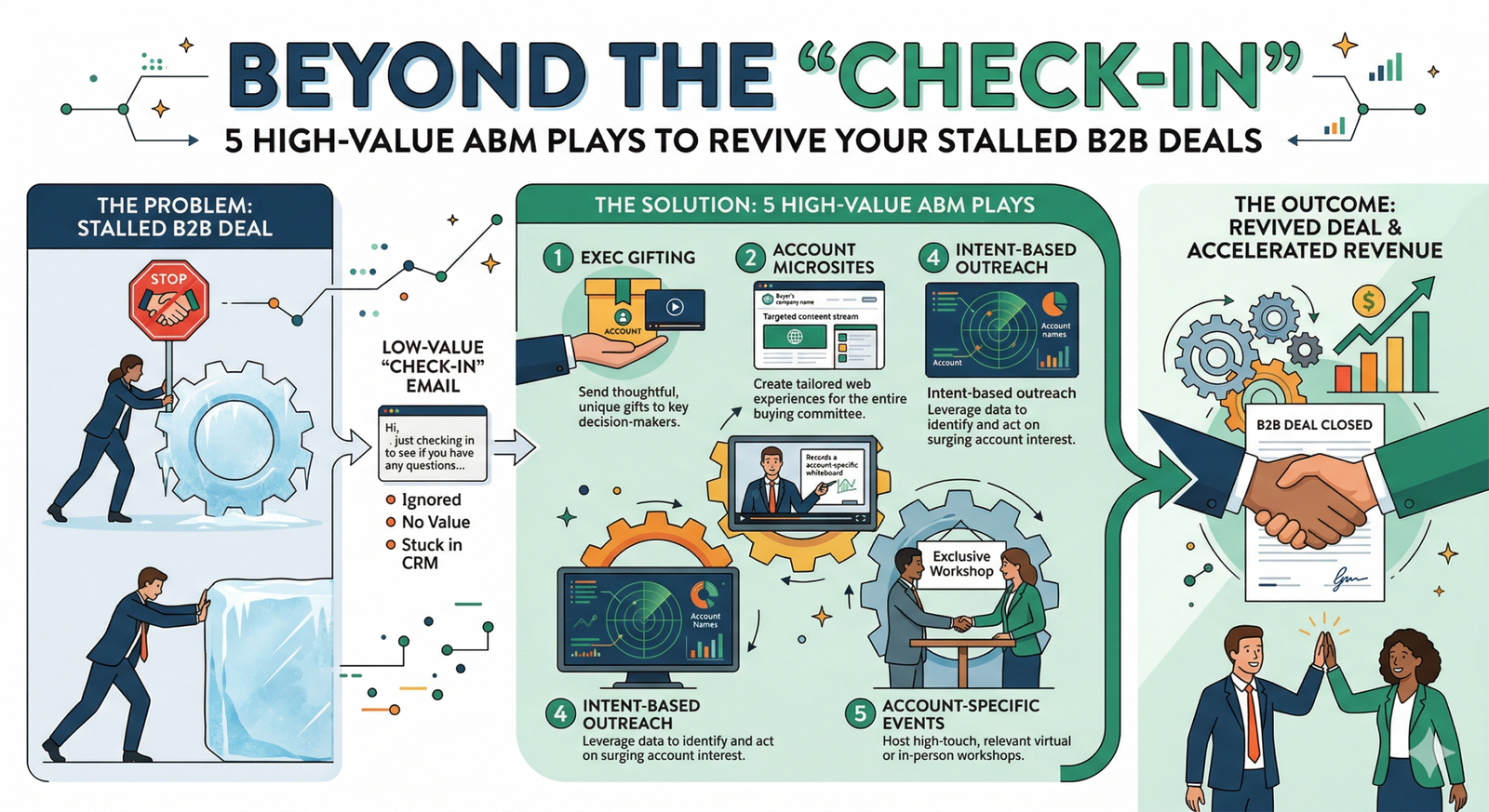
Every B2B sales representative has a “ghost gallery”—a list of high-value target accounts that once showed immense promise. These are the deals that cruised through discovery, attended a deep-dive demo, requested a formal proposal, and then… absolute silence.
In a traditional sales model, this is usually the moment where the “just checking in” emails begin. You’ve seen them, and if you’re being honest, you’ve probably sent them. They are the sales equivalent of a “U up?” text: low effort, zero value, and almost guaranteed to be ignored.
In 2026, the “check-in” isn’t just a weak move; it’s a wasted touchpoint that can actually damage your brand authority. When a high-value opportunity stalls, it’s rarely because the prospect forgot you exist. It’s because the internal buying committee—now averaging 11 stakeholders in enterprise deals—has hit a roadblock. They’ve lost consensus, hit a budget freeze, or been distracted by a more “urgent” internal fire.
To move the needle, you need to stop selling and start enabling. You need personalized Account-Based Marketing (ABM) plays that provide a bridge over their internal friction. Here are five high-value tactical plays to revive your “ghost gallery” and get the revenue engine humming again.
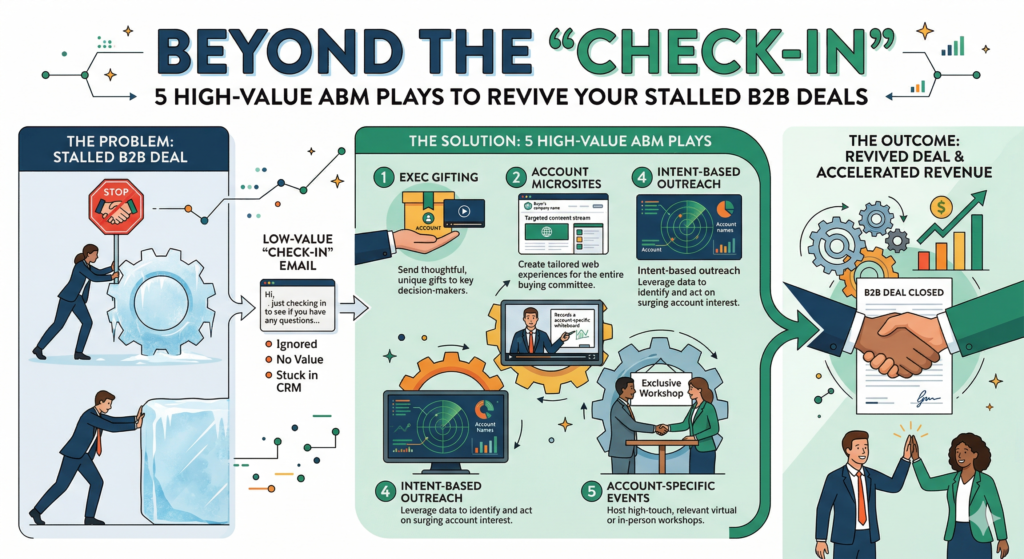
1. The “Executive Alignment” Play
The Scenario: You’ve been multi-threading with mid-level managers. They love the tool, but the deal is stuck in “purgatory” because the C-suite hasn’t prioritized the final sign-off.
The Play: Don’t ask your champion to “push” the boss. Instead, have your CEO or a high-level executive reach out to their counterpart at the target account. This is a peer-to-peer connection designed to elevate the conversation.
- The Strategy: This isn’t a sales pitch. It’s a strategic inquiry. Your executive should frame the outreach around the prospect’s broader 2026 strategic goals.
- The Message: “Our teams have been collaborating on [Project X]. I wanted to reach out personally to ensure our proposed partnership aligns with your department’s vision for the coming year, or to see if there are broader organizational gaps we should be mindful of.”
- Why it works: It shifts the perception of your company from a “vendor” to a “partner.” It also gives the target executive a “safe” space to voice high-level concerns that mid-level managers might have been too intimidated to share.
2. The “Custom Insights Report” Play
The Scenario: During discovery, the prospect acknowledged a problem, but they don’t seem to feel the “burn” of the status quo yet. They are content to wait.
The Play: Use your internal data or third-party benchmarking tools to create a bespoke Value Gap Analysis or Industry Benchmark Report specifically for that account.
- The Strategy: Don’t send a generic whitepaper. Send a report that features their company name on the cover. Show them exactly how much they are losing by staying still.
- The Message: “We’ve been analyzing industry shifts for 2026, and we noticed that while your competitors are seeing a 15% shift toward [Trend], your current infrastructure might be creating a bottleneck here. We ran some preliminary numbers for your specific workflow…”
- Why it works: It leverages loss aversion. B2B buyers are often more motivated by the fear of losing ground to competitors than the hope of gaining efficiency.
3. The “Third-Party Validation” Play (The Hero Story)
The Scenario: The prospect is paralyzed by the risk of implementation. They are “stalled” because they are afraid of making a high-profile mistake that could affect their career.
The Play: Forget the generic case study PDF. Instead, send a 1:1 video or a personalized invitation for a “no-sales” peer call with a customer who was in their exact position—same industry, same legacy tech, same initial hesitation.
- The Strategy: Humanize the success story. Use a customer who can speak the “unvarnished truth” about the implementation process.
- The Message: “I know we discussed your concerns about [Specific Integration]. I wanted to share how [Company Name] navigated that exact hurdle last quarter. Their Head of IT is open to a 15-minute peer-to-peer chat if you’d like to hear how they handled the transition.”
- Why it works: Social proof is powerful, but peer-to-peer validation is surgical. It removes the “Sales vs. Buyer” friction and replaces it with a “User vs. Problem” collaboration.
4. The “Direct Mail: The Physical Re-Engagement” Play
The Scenario: Digital fatigue has set in. Your emails are being opened, but your “Reply Rates” have flatlined. Your prospect is “digitally overwhelmed.”
The Play: Send a high-value, thoughtful physical gift that ties back to a specific pain point discussed in earlier meetings.
- The Example: If they mentioned during discovery that their team is pulling late nights to manage a manual process, send a “Team Recovery Kit” (premium coffee, high-end snacks, or wellness items) with a handwritten note.
- The Message: “I know the team is pushing hard to get [Project Name] over the line. Hope this helps the late nights. Looking forward to helping you automate [Process] so these marathons become a thing of the past.”
- Why it works: In a world of 500 emails a day, physical mail has a near 100% open rate. It triggers the law of reciprocity—when you do something thoughtful, the recipient feels a natural social urge to respond.
5. The “Content Air Cover” Play
The Scenario: The account has gone completely dark. Any further direct outreach from the sales rep will start to feel “pushy” or desperate.
The Play: Pivot from Sales outreach to Marketing “Air Cover.” Use LinkedIn Matched Audiences to run hyper-targeted ads specifically for the 5-10 stakeholders in that stalled account.
- The Strategy: This is about “silent selling.” Don’t show them product feature ads. Show them Thought Leadership content that addresses the specific objection you suspect is stalling the deal (e.g., “The Hidden Costs of Technical Debt in 2026”).
- Why it works: It keeps your brand top-of-mind in a non-intrusive way. When the stakeholder sees your expert content in their feed, it reinforces your authority. When Sales eventually reaches back out in two weeks, the “follow-up” feels like a natural progression of a thought-leadership conversation rather than a cold poke.
The Revenue Sync Checklist
Tactics are useless without coordination. These plays are resource-intensive and require Sales and Marketing to be in total lockstep. Use this checklist during your weekly Revenue Sync to decide which “ghosts” are worth haunting.
| Step | Action Item | Responsibility |
| 1. Diagnosis | Identify the real blocker (Budget, Technical Fear, Internal Politics). | Sales |
| 2. Tiering | Confirm the account is a “Tier 1” ICP with an LTV that justifies the cost. | Sales + Marketing |
| 3. Play Selection | Choose one of the 5 plays based on the blocker identified in Step 1. | Unified Team |
| 4. Asset Prep | Build the custom report, gift kit, or LinkedIn ad creative. | Marketing |
| 5. The Launch | Deploy the play (The CEO email, the Direct Mail, or the Ad Campaign). | Sales / Executive |
| 6. Sentiment Tracking | Monitor for “Digital Body Language” (Ad clicks, site visits, or replies). | RevOps |
The Golden Rule: Don’t Chase Everyone
The biggest mistake in B2B is treating every lead equally. Success with these plays depends on your account selection criteria. Do not deploy an “Executive Alignment” play for a lead that doesn’t fit your Ideal Customer Profile (ICP).
Only deploy these high-touch plays for accounts that:
- Fit your Tier 1 ICP perfectly.
- Have a high “Likelihood to Close” based on previous engagement levels.
- Represent a significant enough Lifetime Value (LTV) to justify the manual effort.
Key Takeaway: Stalled deals aren’t dead deals; they are just “undernourished.” By shifting from generic follow-ups to personalized account plays, you demonstrate that you aren’t just looking for a transaction—you’re looking to solve their problem.