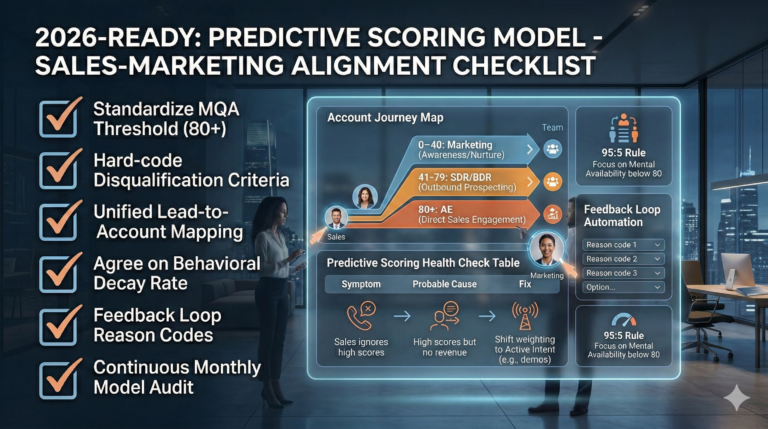
In the high-stakes world of B2B sales in 2026, “gut feeling” has been replaced by data-driven precision. As buying committees expand and cycles lengthen, Predictive Account Scoring has become the essential filter for cutting through market noise.
By using machine learning (ML) to analyze historical patterns and real-time signals, these models identify hidden “ready-to-buy” clusters that human analysts might miss. This guide provides the technical roadmap to turning your CRM into a predictive powerhouse.
The Core Data Pillars of Predictive Scoring
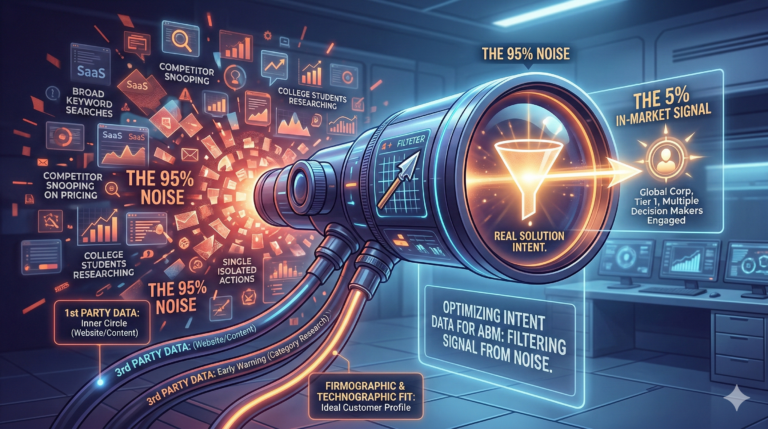
A predictive model is only as good as its “data lake.” To build a robust system, you must feed your model four distinct data types:
| Data Pillar | Focus | Examples |
| Firmographic | Company Profile | Size, industry, revenue, geography. |
| Technographic | Tech Stack Fit | Use of AWS vs. Azure, current CRM (Salesforce/HubSpot). |
| Behavioral (1st Party) | Direct Engagement | Website visits, downloads, webinar attendance. |
| Intent (3rd Party) | External Research | Category research on G2, TrustRadius, or Bombora. |
5 Steps to Setting Up Your Predictive Model
1. Define Your Ideal Customer Profile (ICP)
Analyze your “Closed-Won” data from the past 24 months to find your “North Star.” Identify commonalities in target industries, revenue tiers ($50M–$200M is often the mid-market “sweet spot”), and the specific roles that initiate first contact.
2. Data Cleansing and Integration
Models fail when fed “dirty” data. De-duplicate records and standardize fields (e.g., mapping “US” and “USA” to a single value). Use orchestration tools like Clay or Breeze Intelligence to enrich records automatically.
3. Configure Attributes and Weighting
While the AI determines exact weights, you must select the features it evaluates.
- Positive Signals: Multiple users from the same domain visiting the pricing page; demo attendance.
- Negative Signals: Career page visits (job seekers); presence of a competitor’s non-displaceable tech stack.
4. Model Training and Validation
Most modern CRMs require a training set of 40–100 historical outcomes. Once built, check the AUC-ROC score (a technical metric for accuracy). If your model cannot distinguish a high-value prospect from a “window shopper” with at least 70-80% accuracy, you need better attribute selection.
5. CRM Workflow Integration
A score is useless if it’s hidden. Integrate it into your daily operations:
- Score > 85: Route directly to an Account Executive (AE) for 1:1 outreach.
- Score 50–80: Enter a “high-intent” automated marketing nurture track.
Traditional vs. Predictive Scoring
Many teams confuse manual rule-based scoring with true predictive AI. Here is the 2026 breakdown:
- Traditional (Rule-Based): Uses manual “If/Then” logic. It is static, requires constant manual updates, and is often prone to human bias.
- Predictive (AI-Driven): Uses ML algorithms. It is dynamic, learns from every new win or loss, and can objectively handle hundreds of variables simultaneously.
Top CRM Tools for Predictive Scoring in 2026
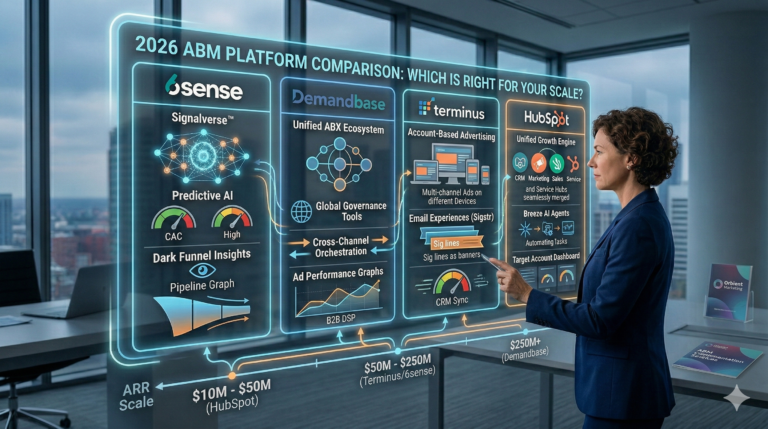
- Salesforce (Einstein AI): The enterprise gold standard. Its “Account Intelligence” identifies conversion likelihood based on CRM data and external news triggers.
- HubSpot (Breeze AI): The mid-market favorite. Deeply integrated with the Breeze intelligence layer, making it accessible for teams without dedicated data scientists.
- Microsoft Dynamics 365 (Sales Insights): Perfect for Microsoft-centric teams, leveraging LinkedIn Sales Navigator data for propensity-to-buy accuracy.
Measuring Success: Sales Velocity
The goal of predictive scoring is to accelerate your revenue engine. Use this formula to measure the impact:

If your model is effective, you will see the Win Rate increase and the Length of Sales Cycle decrease for high-scored accounts.
Best Practices for 2026
- The Feedback Loop: Hold monthly “Score Audits.” If Sales flags a “90-score” account as junk, the model needs re-tuning.
- Account-Based Everything: Ensure your model aggregates scores across all contacts at a specific company, rather than scoring individuals in isolation.
- Time Decay: Behavioral scores must “decay.” A whitepaper download from six months ago is “noise”; a pricing page visit from yesterday is a “signal.”
Summary
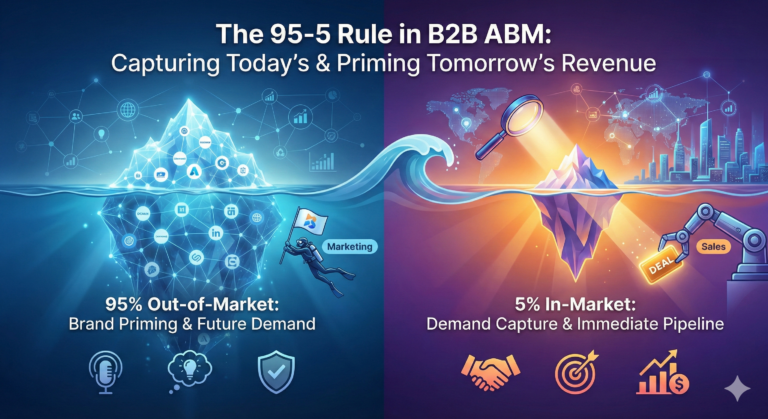
Predictive scoring moves your team from reactive guessing to proactive engagement. By aligning your data pillars and maintaining a tight feedback loop, you ensure your AEs are always focused on the 5% of the market ready to buy today.

What Happens When Strategy Meets Precision? Results.
Learn how our tailored, tech-forward campaigns drive growth for SaaS and B2B companies. From automation to acquisition, devising strategy, engineering growth and retention we optimise every touchpoint.