The 95-5 Rule in B2B ABM: Why Most of Your Future Revenue Is Being Ignored
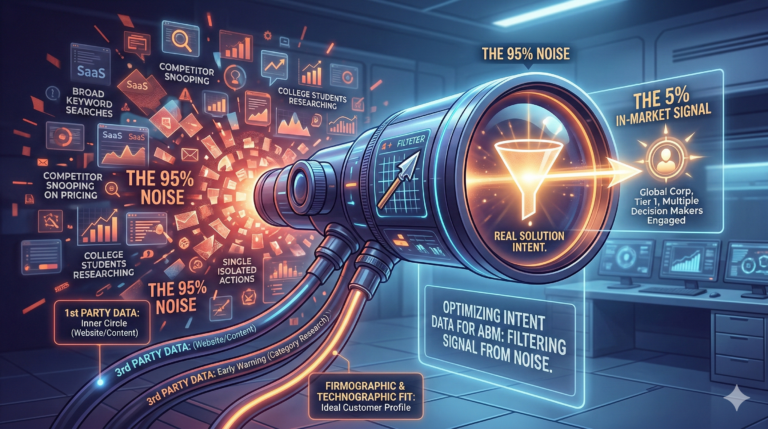
In the high-stakes world of B2B enterprise sales, there is a hard truth many marketing organisations ignore: at any given moment, 95% of your target accounts are not in the market for your services.
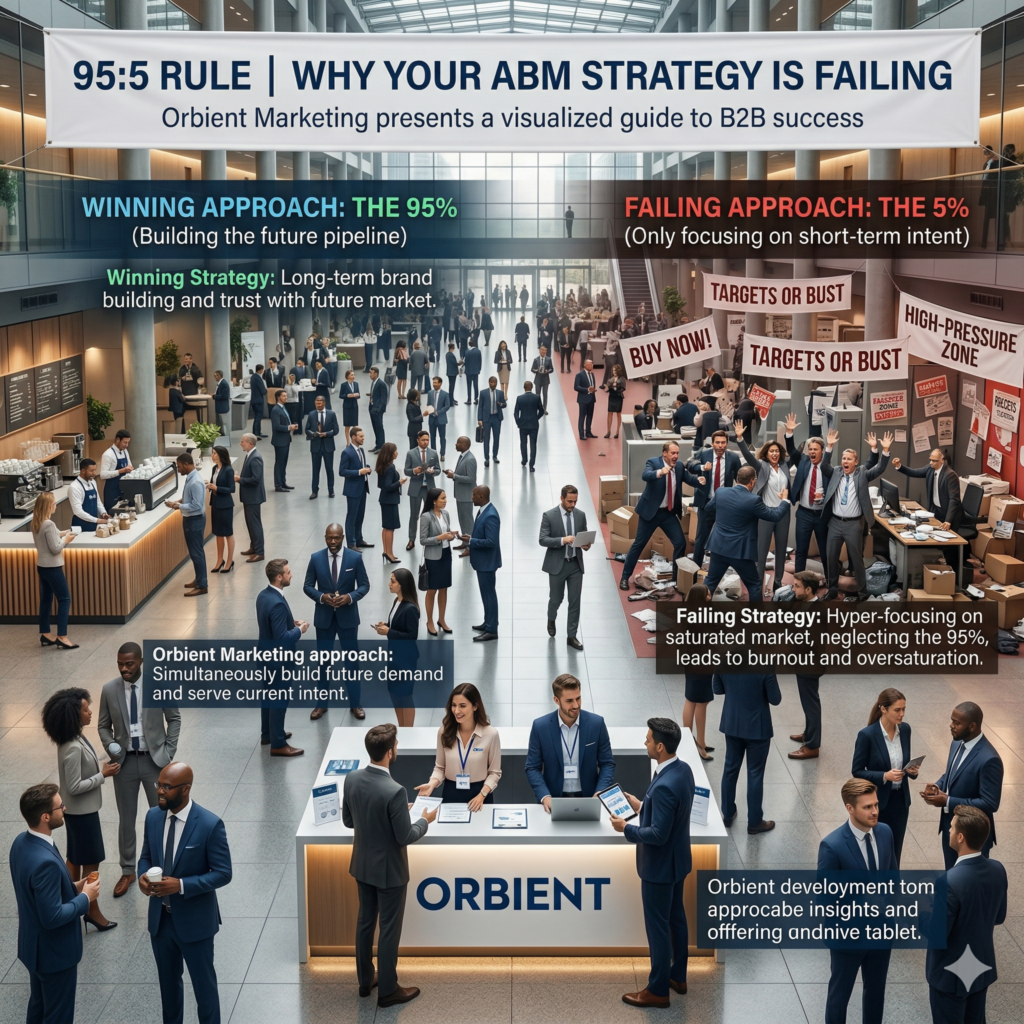
This concept, popularised by Professor John Dawes and the Ehrenberg-Bass Institute, is known as the 95-5 Rule. It suggests that only 5% of B2B buyers are “in-market” at any one time. The other 95% are “out-of-market” and may not be ready to buy for months—or even years.
For CMOs and growth leaders, this changes everything about ABM strategy and implementation. If your current Account-Based Marketing approach is focused only on capturing immediate demand, you are ignoring the vast majority of your future revenue. We help B2B organisations with their B2B ABM Strategy & Implementation.
What Is the 95-5 Rule in B2B Marketing?
The 95-5 Rule explains that in B2B markets, only a small percentage of buyers are actively looking to purchase at any given time.
That means:
- 5% of accounts are ready to buy now (in-market)
- 95% of accounts are not ready yet (out-of-market)
Most ABM programs over-invest in the 5% and under-invest in the 95%. The result is short-term activity with weak long-term growth.
Why the 95-5 Rule Matters for ABM
If your ABM strategy is built only around intent signals and bottom-of-funnel conversion, you are competing late in the buying journey.
By the time a buyer shows intent, they often already have a shortlist of brands in mind. If your brand has not been visible during their out-of-market phase, you are trying to win without familiarity, trust, or mental availability.
This is why modern ABM must do two jobs at the same time:
- Demand Capture – engaging the 5% who are ready to buy today
- Brand Priming – building familiarity with the 95% who will buy tomorrow
The Fatal Flaw in Modern ABM
Most ABM campaigns are built around activation.
A typical flow looks like this:
- use intent data to identify active accounts
- target them with “Book a Demo” messaging
- pass responses to Sales
This can work for short-term pipeline, but it misses the bigger opportunity.
The problem is not activation itself. The problem is relying on activation alone.
If you are only speaking to buyers once they enter the market, you are arriving late to the conversation.
How to Build an ABM Strategy That Respects the 95-5 Rule
To win in 2026, your ABM strategy should be intentionally split into two layers:
1) Demand Capture (The 5%)
This is your conversion engine for accounts actively researching solutions.
Focus areas:
- speed to engagement
- relevant messaging
- sales follow-up
- pipeline acceleration
2) Brand Priming (The 95%)
This is your long-term growth engine for future buyers.
Focus areas:
- visibility
- trust
- education
- mental availability
Together, these create a stronger ABM system that supports both immediate revenue and future pipeline.
Step 1: Data-Driven Account Selection
Effective ABM starts with knowing who belongs in your target universe.
At Orbient Marketing, we move beyond basic firmographics. We use predictive account scoring to identify the accounts that best match your Ideal Customer Profile (ICP), whether or not they are actively searching for a solution.
Why this matters:
- You focus resources on the right-fit accounts early
- You reduce wasted spend on low-potential targets
- You build relationships before an RFP even exists
When you target the right accounts before they show intent, you are not just waiting for a signal—you are shaping future preference.
Step 2: Sales and Marketing Alignment (The Unified Revenue Team)
The 95-5 Rule demands a real bridge between Sales and Marketing.
Sales teams are naturally focused on the 5% (the “now”). Marketing must also act as the steward of the 95% (the “future”).
Strong ABM sales and marketing alignment ensures that:
- Marketing warms up the 95% with high-value, educational content that builds trust
- Sales receives warm account insights when a target moves from the 95% into the 5% buying window
This alignment reduces pipeline friction and improves handoffs. When an account is ready to talk, your brand is already familiar—not a cold introduction.
Step 3: Orchestrating Tailored Account Plays
You cannot treat the 95% and the 5% the same way.
Your ABM campaign orchestration should run at two different speeds, with different goals, tactics, and measurement.
For the 95% (The Out-of-Market Group)
Goal: Brand awareness and education
Best-fit tactics:
- thought leadership articles
- podcasts
- educational content
- no-friction resources
- content that solves day-to-day pain points without asking for a meeting
Key metric: Account reach and engagement depth
This stage is about building familiarity and trust over time, not forcing conversion too early.
For the 5% (The In-Market Group)
Goal: Conversion and pipeline velocity
Best-fit tactics:
- personalised demos
- ROI calculators
- direct outreach sequences from Sales
- high-intent landing pages
- tailored commercial messaging
Key metric: Meeting rate and pipeline value
This stage is about helping buyers make a confident decision quickly.
Step 4: Measuring the ROI of ABM
One of the biggest challenges for CMOs is proving ABM pipeline impact.
If you only measure leads, the 95-5 Rule can make your marketing look like it is underperforming—especially when much of your effort is designed to build future demand.
Instead, measure ABM performance at the account level.
Better ABM Metrics to Track
- Account Penetration
Are you reaching multiple stakeholders across the buying committee? - Engagement Depth
Are target accounts consuming content meaningfully over time? - Sales Cycle Length
Is your cycle shortening as brand familiarity increases? - Win Rate
Are you converting more in-market accounts because trust is already established?
When you prime the 95% effectively, your performance with the 5% improves dramatically.
Why ABM in 2026 Must Move from Lead Gen to ABX
The transition from reactive lead generation to a proactive, account-based experience (ABX) is one of the most significant competitive advantages a B2B firm can build in 2026.
ABX strengthens performance because it treats the buyer journey as ongoing—not just a moment of intent.
That means:
- better timing
- better relevance
- better alignment between teams
- better long-term pipeline creation
Final Thoughts: Don’t Leave 95% of Your Market to Competitors
The 95-5 Rule is not just a theory—it is a practical lens for building smarter ABM programs.
If your strategy only targets buyers when they are already in-market, you are leaving future revenue on the table. The brands that win are the ones that build trust before buyers are ready to buy.
By combining:
- data-driven account selection
- sales and marketing alignment
- tailored plays for the 95% and the 5%
- account-level performance measurement
…you can create an ABM strategy that drives both immediate pipeline and long-term growth.
Ready to Master the 95-5 Rule?
At Orbient Marketing, we specialise in the implementation of ABM strategies that respect the reality of the buyer’s journey.
We help you:
- identify priority accounts
- deliver targeted account plays
- build a scalable ABM/ABX approach
- strengthen sales performance over time
Don’t leave 95% of your market to your competitors. Book a FREE consultation with our ABM experts today. We help B2B organisations with their B2B ABM Strategy & Implementation.

What Happens When Strategy Meets Precision? Results.
Learn how our tailored, tech-forward campaigns drive growth for SaaS and B2B companies. From automation to acquisition, devising strategy, engineering growth and retention we optimise every touchpoint.