In the high-stakes world of B2B Account-Based Marketing (ABM), intent data is often hailed as the “holy grail.” We’re told it’s a digital crystal ball that reveals exactly who is ready to buy and when. But if you’ve spent any time staring at a dashboard full of “surging” accounts that never return a sales call, you know the truth: most intent data is just noise.
By 2026, the challenge isn’t getting more data; it’s finding the signal. With the “95:5 rule” reminding us that only 5% of your market is looking to buy at any given time, pouring resources into the other 95% because they clicked a single link is a recipe for budget burnout.
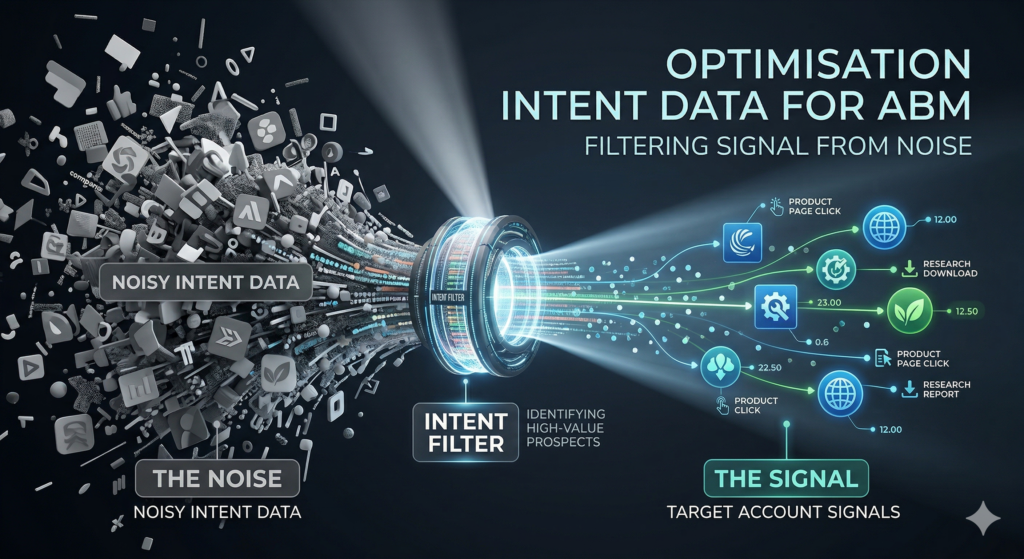
1. Define the “Noise”: Why Data = Intent
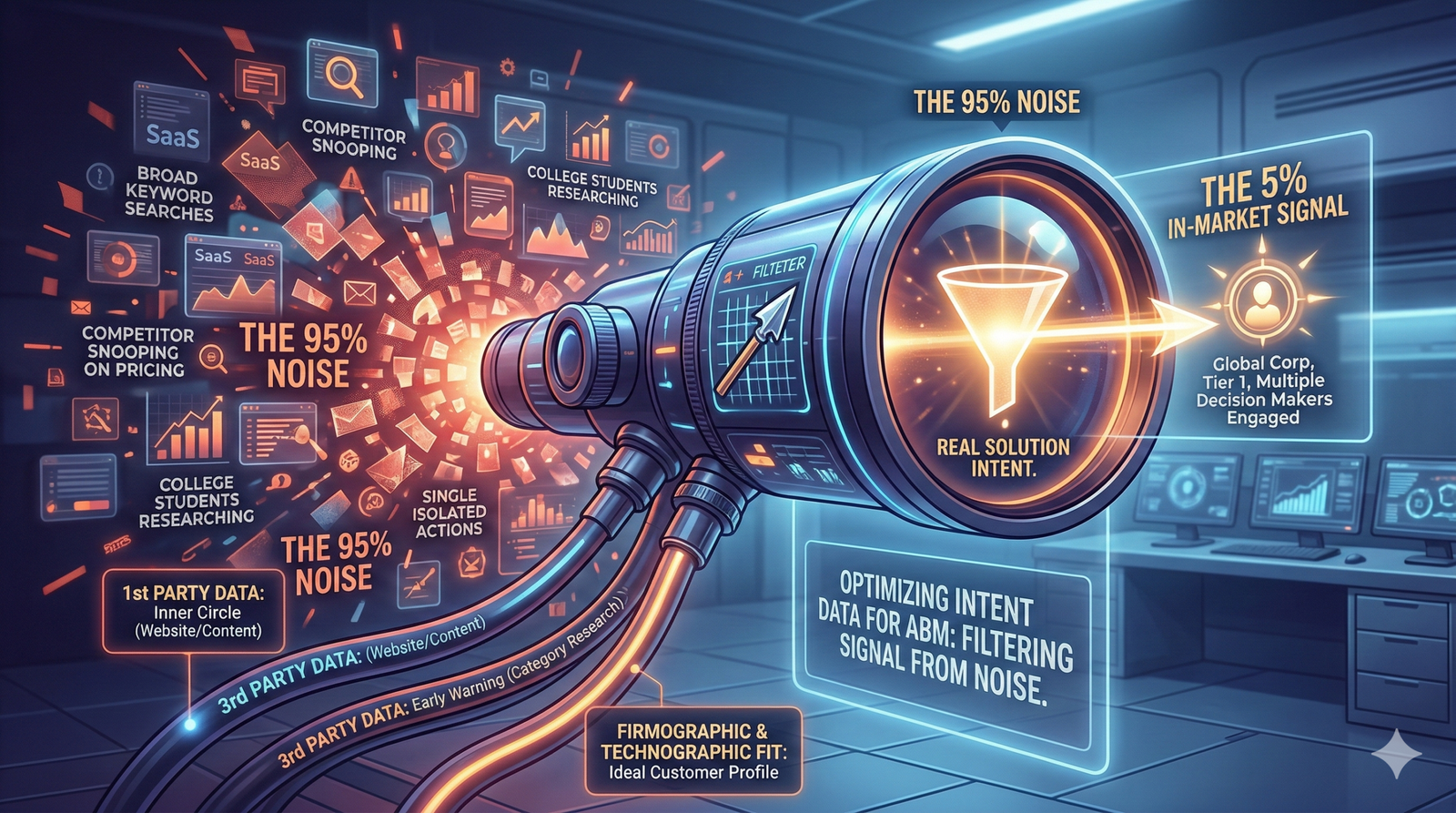
In ABM, “noise” is any data point that suggests interest without indicating a purchase journey. This includes:
- The “Tourist”: An employee at a target account researching a broad topic for a college course or a blog post.
- The “Competitor”: Your rivals snooping on your pricing page.
- The “Static”: Single, isolated actions that don’t repeat or escalate.
If your sales team is chasing every account that triggers a “keyword surge” for a broad term like “SaaS,” they aren’t doing ABM—they’re doing digital archeology. Real intent is a pattern, not a point.
2. The Three Pillars of Signal Detection
To find the signal, you need to triangulate. Relying on a single source of intent is like trying to navigate with a one-dimensional map.
A. First-Party Data: The “Inner Circle”
This is data you own: website visits, webinar attendance, and high-value content downloads (like pricing guides or ROI calculators).
- The Signal: When three different people from the same account visit your “Integrations” page within 48 hours. That is a high-intensity signal.
B. Third-Party Data: The “Early Warning System”
This is behavior across the web—researching topics on Gartner, G2, or industry publications.
- The Signal: An account that has never visited your site but is suddenly “surging” on 10+ keywords related to your specific niche (e.g., “SOC 2 compliance automation”).
C. Technographic & Firmographic Fit
Intent is useless if the account can’t actually buy from you.
- The Filter: Overlay intent signals with your Ideal Customer Profile (ICP). If a company is showing massive intent but only has 10 employees and your product starts at $50k/year, that’s noise.
3. The “Signal-to-Action” Playbook
Once you’ve filtered the signals, you need a tiered response. In 2026, successful ABM teams use a Dynamic Tiering model:
| Signal Strength | Account Status | Marketing Play | Sales Action |
| Low (Static) | Awareness Stage | Generic “Thought Leadership” ads | No active outreach |
| Medium (Topic Interest) | Consideration | Multi-channel ads on that specific topic | Social selling (LinkedIn) |
| High (Solution Intent) | Decision Stage | Hyper-personalized 1:1 landing pages | Immediate SDR/AE outreach |
Export to Sheets
4. Leveraging AI for Real-Time Filtering
Manually sifting through spreadsheets is a relic of 2022. Modern ABM platforms now use Predictive Intent Models. These AI layers analyze the velocity of research.
Instead of telling you “Account X is interested,” they tell you:
“Account X’s research intensity has increased by 40% this week compared to their historical baseline, and they are looking at your direct competitor’s comparison pages.”
That is a signal you can take to the bank.
5. Cleaning Your “Data House”
You cannot find a signal in a messy CRM. Before you buy more intent data, ensure your internal records are clean:
- Map Leads to Accounts: If “John Doe” downloads a whitepaper, but your CRM doesn’t link him to the “Microsoft” account, you lose the signal.
- Set Decay Models: Intent has a half-life. A “surge” from three months ago is now noise. Ensure your scoring models automatically “decay” old activity.
The Bottom Line
Optimizing intent data for ABM isn’t about casting a wider net; it’s about sharpening your spear. When you filter out the “tourists” and focus on the accounts where fit meets frequency, you stop being a “marketer” and start being a revenue generator.
When an account hits that “High Intent” threshold, speed is everything—but relevance is the real closer. You don’t want to say, “I saw you looking at our pricing page” (that’s a bit too Big Brother). Instead, position yourself as a timely resource appearing exactly when they have a problem to solve.

What Happens When Strategy Meets Precision? Results.
Learn how our tailored, tech-forward campaigns drive growth for SaaS and B2B companies. From automation to acquisition, devising strategy, engineering growth and retention we optimise every touchpoint.