
In many B2B organisations, the “Target Account List” (TAL) is where Account-Based Marketing (ABM) goes to die.
Marketing spends weeks pulling data, filtering by industry, and presenting a shiny list of 500 companies to the Sales team. Sales takes one look, sees a dozen “unworkable” accounts, and quietly reverts to their own spreadsheets. The result? A fragmented strategy, wasted ad spend, and the “us vs. them” mentality that ABM was supposed to fix.
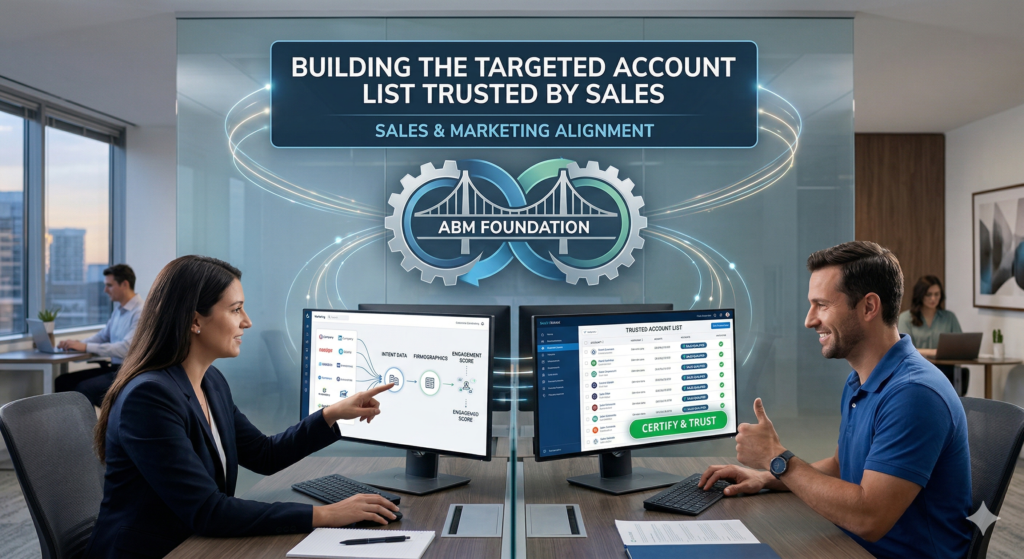
Building a target account list that Sales actually believes in isn’t a data exercise—it’s a collaborative process. If you want your ABM sales and marketing alignment guide to actually work, you need a TAL built on shared conviction, not just shared spreadsheets.
1. Start with “Negative” Selection Criteria
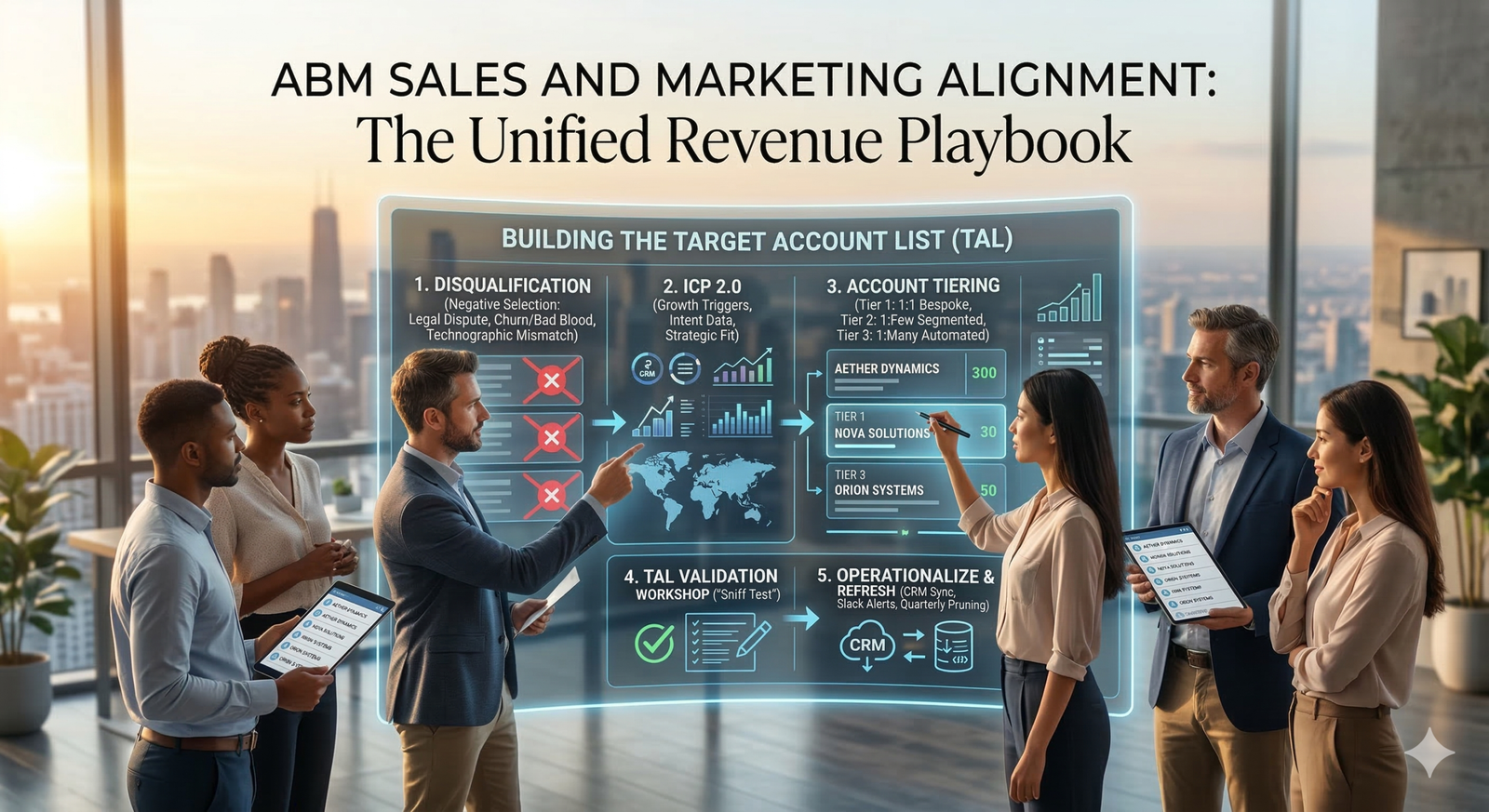
The fastest way to lose Sales’ trust is to include accounts they know they can’t win. Before you look at who you want, define who you don’t want.
This is the “Disqualification Phase” of your B2B account selection criteria. Work with Sales to identify:
- Existing “Landmines”: Accounts currently in a legal dispute or those that recently churned with “bad blood.”
- Technographic Mismatches: Companies using a competitor’s solution with a three-year contract signed last month.
- The “No-Go” Segments: Industries where your product-market fit is historically weak, even if they match your revenue filters.
By stripping these out early, you show Sales that you value their time and frontline intel.
2. Define Your Ideal Customer Profile (ICP) 2.0
Most ICPs are too shallow. To build a TAL with teeth, you need to go beyond basic firmographics (revenue, headcount, geography). Your B2B account selection criteria should include:
- Growth Triggers: Has the company recently received a Series C? Have they hired a new VP of Operations? These are signals of a budget shift.
- Intent Data (The “Secret Sauce”): Use tools like 6sense or Bombora to identify accounts researching your specific category. If a Tier 1 account is actively looking for “Scalable ABM tactics for mid-market,” they belong on the list today, not next quarter.
- Strategic Fit: Does this account help you break into a new vertical? Is it a “trophy” logo that will make winning others easier?
3. The “Account Tiering” Framework
Not all accounts are created equal. A common mistake is treating a list of 200 accounts with the same level of intensity. To maintain alignment, categorize your TAL into three tiers:
| Tier | Strategy | Description |
| Tier 1 (1:1) | Bespoke | High-value “must-wins.” Marketing creates custom content; Sales spends hours on deep research. |
| Tier 2 (1:Few) | Segmented | Groups of 10–20 accounts with shared pain points. Use personalized account plays B2B leaders relate to. |
| Tier 3 (1:Many) | Automated | Broad reach using scalable ABM tactics for mid-market. High automation, low manual effort. |
Sales Buy-In Tip: Let the Sales reps choose their own Tier 1 accounts. When they “own” the selection, they are far more likely to follow through on the plays.
4. Validate with the “Sniff Test”
Once the data-driven list is ready, hold a TAL Validation Workshop. This is a 60-minute session where Marketing presents the “Candidate List” and Sales “sniffs” out the duds.
Ask Sales: “Why should this account NOT be on the list?” If a rep says, “I know their VP of Procurement, and they’re frozen until 2027,” believe them. Remove the account. This transparency builds the bridge for true ABM sales and marketing alignment.
5. Operationalize the List (The “Action” Phase)
A list is just a document until it’s in the CRM. To make the TAL “real,” ensure:
- CRM Tagging: Accounts must be clearly tagged as “ABM Target – Tier X.”
- Alerting: Set up Slack or Email alerts for Sales when a TAL account visits the pricing page or downloads a whitepaper.
- Content Mapping: Marketing should show Sales exactly which assets are ready for each account tier. If Sales sees that Marketing has already built a custom deck for their Tier 1 account, they’ll be chomping at the bit to use it.
6. The 90-Day “Refresh” Cycle
The B2B landscape changes fast. An account that was a “Perfect Fit” in January might be irrelevant by April due to an acquisition or a pivot.
Schedule a quarterly TAL review. This isn’t just about adding new names; it’s about “pruning” the list. If an account hasn’t engaged despite personalized account plays, move it back to the general marketing pool and bring in a “warm” prospect from the Tier 2 waiting list.
Conclusion: Data + Intuition = Revenue
A Target Account List that Sales believes in is a blend of Marketing’s data and Sales’ intuition. When you move away from “sending lists” to “building strategy,” you stop being two departments and start being a Unified Revenue Team.
By using rigorous B2B account selection criteria and focusing on scalable ABM tactics for mid-market, you ensure that every dollar spent by Marketing and every hour spent by Sales is focused on the accounts most likely to close.